

Using a VPN for Online Casinos and Slots: Pros, Cons, and What You Should Know
You’re at an airport, flight delayed by two hours, and the departures board hasn’t changed in forty minutes. You open your phone, connect to the terminal Wi-Fi, and decide to pass the time on your casino account. It takes maybe twenty seconds. What you probably didn’t think about is that public airport Wi-Fi is, by most security standards, a shared network with strangers — and your login credentials just travelled across it unencrypted. That’s the moment a lot of players start wondering whether they should be doing this differently.
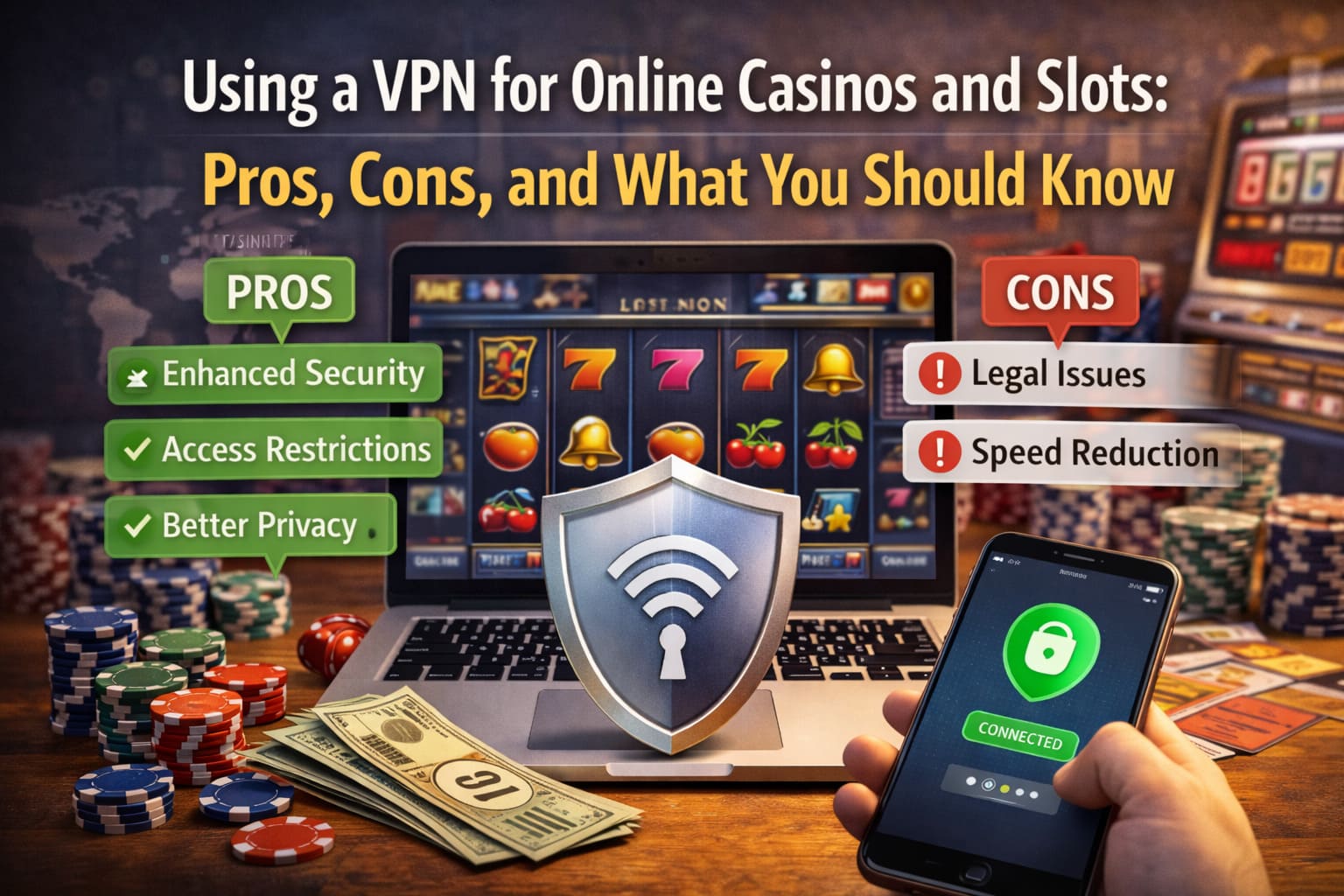
The VPN question comes up a lot in online gambling circles. Not always for the same reasons, either. Some players are genuinely privacy-conscious and use a VPN for everything — banking, email, shopping. Others have run into access issues while travelling and started looking for solutions. And some have simply heard that casino sites can behave differently depending on your location, and they’re not sure what that means for their account. All of these are reasonable starting points, even if the answers aren’t simple.
This isn’t a guide to getting around blocks or making yourself look like you’re somewhere you’re not. The aim is more useful than that: explain what a VPN actually does, why players reach for one, and where the real benefits and risks sit. Laws differ by country, sometimes by state or province. Casino terms vary from one platform to the next. None of this should be read as legal advice — it’s context to help you ask better questions before making decisions.
Context matters here more than people often realize. When players compare notes on forums or casino review sites, they’ll reference a wide mix of platforms — someone might mention jackpot-jill.com alongside several others when discussing how account terms, eligible countries, and verification policies can differ significantly between sites. Those differences are real, and once a VPN is in the mix, they become more consequential.
The honest summary is this: a VPN can make your connection more secure in certain situations, and that’s a legitimate thing to care about. But it also creates complications that are specific to gambling accounts — some minor, some serious — depending on the platform, what country you’re in, and what you’re actually trying to do. The rest of this piece breaks that down plainly.
What a VPN Actually Does
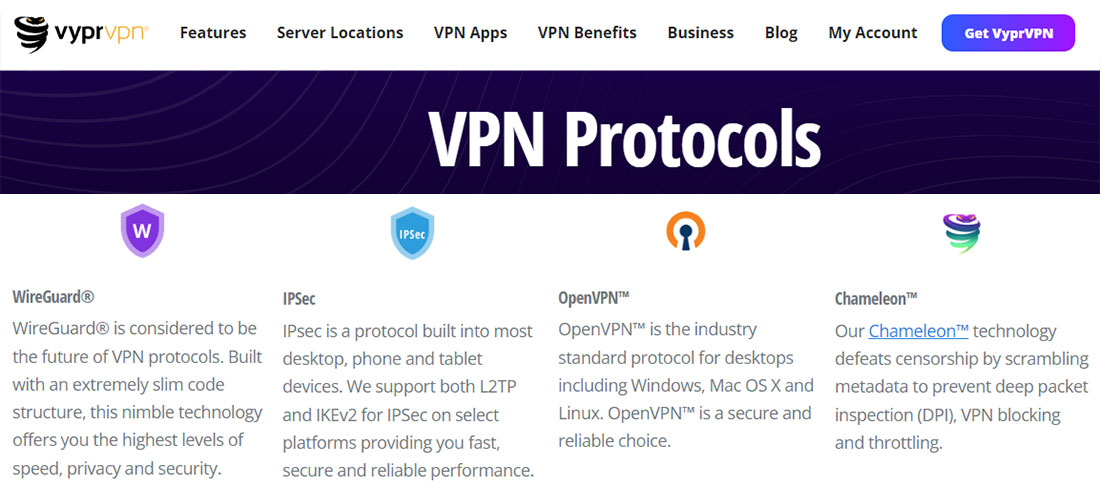
A VPN — Virtual Private Network — routes your internet traffic through a remote server operated by the VPN provider, wrapping that traffic in encryption as it travels. From the website’s point of view, your connection appears to come from the VPN server’s location rather than wherever you actually are. Two things follow from that: your data is harder to intercept in transit, and your real IP address is hidden from the sites you visit.
On a practical level, the encryption part is the most useful. On a trusted home network with modern router security, it doesn’t add much. On a hotel Wi-Fi or a café hotspot — where anyone else on the network could theoretically be watching traffic — encrypting your connection is a sensible precaution for anything sensitive. Casino accounts fit that description. So do banking apps, email, and anything else tied to your identity or money.
What a VPN does not do is just as worth understanding. It doesn’t change the laws that apply to you. Routing your traffic through a server in another country doesn’t alter your legal jurisdiction or make a restricted activity permissible. It doesn’t modify a casino’s terms of service, it doesn’t remove KYC obligations, and it doesn’t prevent platforms from reviewing your account if something looks off. A VPN is a network tool — a fairly specific one — and treating it as a broader fix tends to create more problems than it solves.
Why Some Casino Players Use VPNs
A lot of VPN use in gambling has nothing to do with trying to access something you shouldn’t. People who use a VPN for everything — and there are plenty of them — don’t typically turn it off for casino sessions. It’s just part of how they use the internet. That’s a perfectly reasonable habit, and for most players on most platforms, it causes no issues at all.
Some of the most common, lawful reasons players consider using a VPN when gambling online:
- Public Wi-Fi security — encrypting traffic on airport, hotel, or café networks where interception is a genuine concern
- General privacy from ISP data logging or traffic monitoring
- Concerns about targeted advertising tied to browsing behaviour
- Travel situations where connecting through a familiar server feels more consistent
- Protecting payment credentials on networks they don’t control
- Reducing exposure to third-party data brokers
- Consistent security habits applied across all online accounts, not just gambling
- Corporate devices that route all traffic through a company VPN by default — not always a choice
- General cybersecurity hygiene recommended by an employer or IT policy
- Privacy concerns in jurisdictions with heavier local network monitoring
The problem — and it’s worth being direct about this — is that casino security systems don’t evaluate intent. They look at patterns: IP addresses, login locations, device fingerprints, session behaviour. A player using a VPN for entirely sensible reasons and a player attempting to circumvent eligibility rules can look identical from that vantage point. The system responds to the signal, not the story behind it.
The Benefits (When Used Responsibly)
Stripped of the gambling-specific complications, the security case for VPNs on untrusted networks is well-established. The Electronic Frontier Foundation and similar digital rights organisations have recommended encrypted connections as standard practice for anyone handling sensitive personal or financial data online. A casino account — which holds your name, address, payment details, and identity documents — clearly qualifies.
The table below puts the benefits in context. The pattern you’ll notice: most of them are network-level protections that matter most when the network itself is the problem.
| Potential Benefit | When It Helps | Limits / Caveats |
|---|---|---|
| Encrypted connection | On public Wi-Fi at airports, hotels, cafés | Less necessary on a trusted home network with WPA2/3 encryption |
| IP address masking | Reducing location exposure to third-party trackers | Casinos may flag unfamiliar IPs; account-level tracking continues regardless |
| Protection from ISP data logging | Where ISPs are legally required to retain browsing records | Trust shifts to VPN provider — who may also log data |
| Reduced exposure on shared networks | Corporate networks, shared accommodation, public spaces | Casino terms and legal obligations still apply in full |
| Consistent security across devices | Travellers moving between multiple countries and networks | Frequent IP changes can trigger account security reviews |
One thing that doesn’t get said often enough: not all VPN services are the same product. A paid provider with independently audited no-log policies is a meaningfully different thing from a free VPN app of uncertain origin. With any VPN, your traffic is passing through a third party. The question of whether you trust that party matters — especially when the data involved includes payment credentials and identity documents.
The Risks and Downsides
Here’s where it gets more complicated. Online casinos run fraud detection systems that depend heavily on recognising normal account behaviour. Location data — your IP address and the country it resolves to — is part of that picture. When the pattern shifts without obvious explanation, the system flags it. That might mean a one-time verification prompt, a temporary hold, or a more involved review. The platform isn’t necessarily assuming the worst; it’s following a process designed to catch genuine bad actors that sometimes catches ordinary players in the crossfire.
The most common problems people run into:
- Account flagged for unusual login location — a sudden IP change, especially to another country, is a standard trigger for security reviews
- Temporary lockout pending identity re-verification
- Withdrawal delays while the platform reviews inconsistent location data
- Payment method mismatches — when the card or bank country doesn’t align with the apparent connection location
- Slower connection speeds, particularly noticeable on live dealer games with video streams
- VPN IP addresses appearing on shared blocklists, causing outright connection rejection
- Terms of service violations, potentially affecting account standing or voiding winnings
- Promotional eligibility queries triggered by location inconsistency
- Customer support escalations that take longer to resolve when location history looks complicated
The speed point is worth pausing on. A VPN adds latency — your traffic takes an extra hop through a remote server, and that adds time. For slots it’s usually not noticeable. For live blackjack or roulette with a real dealer on a video feed, even modest latency can make the stream stuttery and the game feel sluggish. Players who’ve switched to a VPN mid-session and noticed the table suddenly running slow have often encountered exactly this. It’s a mundane problem, but an annoying one.
Terms, Jurisdictions, and Why This Matters
Licensed online casinos operate under regulatory frameworks that specify exactly which markets they’re permitted to serve. A licence from the UK Gambling Commission, the Malta Gaming Authority, or another body isn’t a blanket permission to offer services everywhere — it covers particular jurisdictions, and operators are legally required to block players from regions outside their licensed footprint. The VPN restrictions in many casino terms of service exist, at least in part, because of this compliance obligation.
Terms and enforcement practices vary significantly between platforms. Some are explicit about VPN use being prohibited. Others say nothing. A few will confirm current policy if you ask their support team directly — and asking is actually worth doing if you’re unsure. What you don’t want is to discover the platform’s position when you’re trying to withdraw.
| Issue Area | Why It Matters | What Users Should Check First |
|---|---|---|
| Licensing and eligibility | Platforms can only legally serve players in covered jurisdictions | The casino’s terms — usually a “restricted countries” or “eligible players” section |
| VPN clauses in T&Cs | Some platforms explicitly prohibit VPN use; violations can void winnings | Search the terms for “VPN,” “proxy,” and “anonymising software” |
| Local gambling laws | Online gambling legality varies widely — sometimes at the state or province level | Check your jurisdiction’s specific rules, not just the country-level picture |
| Payment processing rules | Banks may decline transactions that appear to originate from unexpected locations | Contact your bank separately if payment failures occur while travelling |
The stakes here aren’t abstract. Terms of service in most jurisdictions are treated as binding contracts. If a platform’s terms prohibit VPN use and a review finds evidence of it, the platform may have grounds to withhold winnings — regardless of the player’s intentions. That’s a consequential outcome for something that might have started as a routine privacy habit. Reading the terms before you need them takes ten minutes; finding out their content after a disputed withdrawal is a much more difficult situation.
KYC, AML, and Account Verification Reality
Know Your Customer and Anti-Money Laundering checks aren’t optional extras that platforms run at their discretion — they’re regulatory requirements, and licensed casinos have to comply with them. In practice, that means identity verification (passport or driver’s licence), proof of address, and sometimes documentation of where deposited funds came from. This typically happens at registration or when a withdrawal crosses a certain threshold.
A VPN plays no role in any of this. Your identity documents say what they say regardless of which IP address your session originated from. If your account shows a residential address in one country, a bank card issued in another, and a connection history showing logins through servers in a third, that’s a pattern that invites scrutiny — not one that passes quietly. In practice, this is where many players get stuck. They’ve used a VPN for privacy reasons, never considered how it looked to the platform’s compliance team, and then hit a wall at the withdrawal stage while location-related inconsistencies are manually reviewed.
The information you submit during KYC needs to be accurate and consistent with your actual situation. That’s not a formality — it’s a requirement with real consequences if it isn’t met. A masked IP address doesn’t change what your documents say, and it doesn’t resolve mismatches that those documents create.
Device Security vs. Access Strategy
There’s a distinction worth being clear about, because it shapes everything else in this topic. Using a VPN to protect your connection on an untrusted network is a device security decision. It’s about reducing the risk that someone on the same Wi-Fi network can read your data in transit. Security professionals, IT departments, and privacy advocates all recommend this kind of protection — it applies to banking, email, and casino accounts equally.
Using a VPN as an access strategy — to reach a platform that would otherwise reject your connection, or to obscure your actual location from a platform’s eligibility checks — is something different. That’s using a privacy tool to potentially circumvent licensing restrictions or account rules. The technical action is identical in both cases. The implications are not.
A VPN may protect the connection. It does not change account eligibility. Keeping that distinction clear avoids a lot of confusion about what you’re actually gaining, and what risks you’re taking on.
How to Make Safer Decisions
Most of what follows is about being deliberate rather than reactive — doing the reading before something goes wrong rather than after. It applies whether you’re using a VPN or not, though VPN users have more specific things to verify.
- Read the platform’s terms of service before creating an account — specifically the sections covering eligible countries and any mention of prohibited software
- Confirm that you are in an eligible jurisdiction based on your actual location, not an apparent one
- Search the terms for “VPN,” “proxy,” or “anonymising software” to understand the platform’s position
- Keep your account information — address, payment methods, contact details — accurate and consistent throughout
- Reserve VPN use for genuinely untrusted networks; on your home broadband, the extra layer usually isn’t necessary
- Contact customer support directly if you’re unsure whether your situation is covered by the terms
- Understand the local laws that apply to you before gambling online at all — country-level rules aren’t always the whole picture
- Avoid completing high-value transactions on public Wi-Fi if a more secure option is available
- Use strong, unique passwords and two-factor authentication — these matter more than VPN use for account-level security
- Keep your payment method consistent with the identity and address on your account
- If you’ve used a VPN and are asked by support about your login history, be straightforward — inconsistency in your explanations causes more problems than the original question
Platforms that enforce their terms strictly tend to do so at the least convenient moment — during a withdrawal, not during registration. The time to understand the rules is before you need to rely on them.
Common Myths About VPNs and Online Casinos
The most persistent myth is that a VPN makes gambling anonymous. It doesn’t come close. Your account is tied to your name, your verified identity documents, your payment methods, and your session history. Masking your IP address removes one data point from that picture. Casinos also use cookies, device fingerprinting, and session tokens that operate entirely at the application layer — a VPN doesn’t touch any of that. Someone who believes their activity is invisible because they’re on a VPN is working from a significant misunderstanding of how the technology works.
The claim that a VPN guarantees security is similarly overstated. It addresses network-level interception — a real threat on public Wi-Fi, but only one category of risk. It does nothing about weak passwords, phishing attacks, or the security practices of the platform itself. Two-factor authentication on your casino account does more for account security than any VPN configuration, and it doesn’t come with the complications.
Finally, VPNs don’t fix payment problems. If your card is being declined because your apparent location doesn’t match your bank’s records, rerouting your traffic doesn’t change what the bank sees when it processes the transaction. Payment issues almost always need to be resolved directly — with your bank, with the casino’s support team, or both. Trying to route around the problem tends to make it harder to explain later.
What to Do If You Travel Frequently
Regular travellers face a version of this problem that stays frustrating precisely because their situation is legitimate. Logging in from London on a Tuesday and from Singapore the following weekend isn’t suspicious behaviour — it’s a normal working life for a lot of people. But it can look unusual to a platform’s security system, which has no way of knowing that you’re a frequent flyer rather than someone sharing account access across multiple locations.
| Travel Situation | Risk Level | Safe Next Step | What Not to Assume |
|---|---|---|---|
| Short trip to another eligible country | Low–moderate | Confirm the destination is on the platform’s approved list before travelling | That eligibility in one country carries over automatically |
| Extended stay abroad | Moderate | Contact support, update account details if required, confirm ongoing eligibility | That previous approval covers new or longer-term situations |
| Transit through a restricted country | High | Avoid logging in; review the terms before doing so | That a VPN resolves the restriction — it doesn’t |
| Regular multi-country travel | Moderate–high | Notify support proactively; keep a record of your travel schedule if asked | That previous logins from multiple locations establish a precedent |
If you travel often, a few questions worth asking a platform’s support team before you leave:
- Is my destination country covered by your licence?
- Will logging in from abroad affect my account in any way?
- Do I need to notify you before I travel?
- Are there account steps I should complete before departing?
- What’s the process if my login triggers a security review from an unfamiliar location?
- What documentation might be requested to confirm my identity if my location changes?
A platform with decent customer service will give you usable answers. If the response is vague or you can’t get a straight reply, that’s information too — and it’s better to have it before you’re overseas and locked out of your account at 11pm.
Final Thoughts
A VPN is a legitimate privacy and security tool, and using one to protect your connection on public Wi-Fi is a sensible habit — the same kind security-conscious people apply to online banking, email, and anything else that handles personal data. The complications arise when VPN use intersects with casino eligibility rules, licensing restrictions, and fraud detection systems that are designed to flag unusual patterns. Those systems don’t have much room for nuance. They respond to signals, and an unexpected IP change is a signal.
The clearest path through this is preparation. Know which platforms you’re eligible to use. Understand the local laws that apply to you — not just in general, but specifically. Read the terms before you deposit, not after a dispute. Keep your account information accurate and consistent with your actual identity. A VPN may fit into that picture depending on your situation and the platform’s terms, but no network tool replaces the work of knowing where you stand.
The safest bet when it comes to online casino accounts is knowing exactly where you stand before you log in — not after.